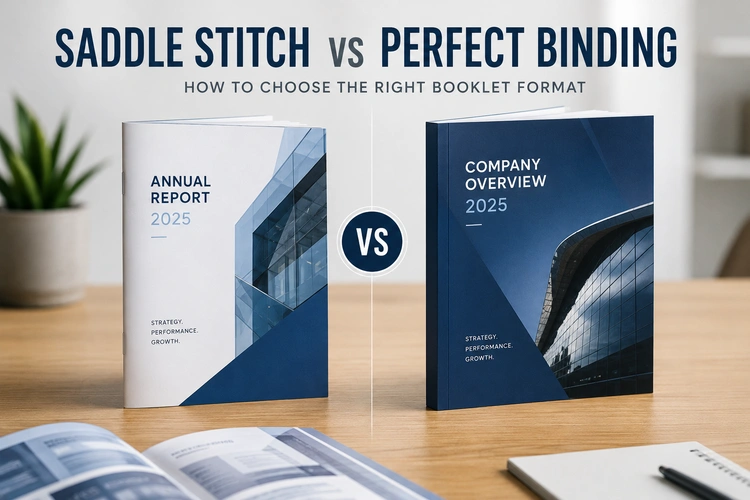
The choice between saddle stitch and perfect binding is often presented as a simple page-count calculation — but most buying decisions are more nuanced than that. When you’re ordering saddle-stitched booklets or weighing up formats for the first time, the right answer depends on how the booklet will be used, what it needs to say about your brand, and how quickly you need it. This guide covers all of it, including a summary table at the end to help you reach a clear decision.
Understanding the production process behind each method makes the specification decisions easier to reason about.
Saddle stitch binding works by folding sheets of paper in half, nesting them inside each other, and driving two wire staples through the spine. The result is a booklet that opens flat, with a slightly curved spine and no separate cover board — the cover is simply the outermost sheet of the document, printed on a heavier stock. The name comes from the saddle-shaped support the folded sheets sit over during stapling.
Perfect binding works differently. Individual pages are printed flat, trimmed, collated, and then clamped in a block while a strip of flexible adhesive is applied along one edge. A separate cover — printed on a heavier card and creased at the spine — wraps around the block and adheres to the glued edge. Once cured, the three open sides are trimmed flush. The result is a flat, square spine that can carry a title, and a finished booklet that looks and feels closer to a paperback book.
The mechanical difference matters because it directly affects what each format can do: saddle stitch produces a curved, open-flat spine suited to lighter, shorter documents; perfect binding produces a rigid, printable spine suited to thicker, more substantial ones.
The standard guidance is that saddle stitch works for booklets up to 64 pages, and perfect binding takes over beyond that. As a starting point, this holds — but the edges deserve some nuance.
The 64-page ceiling on saddle stitch comes from physics. As more folded sheets nest inside each other, the spine becomes progressively harder to fold cleanly and the staples sit less neatly. On standard 130gsm silk inner paper, most printers find that 64 pages is the practical maximum before the result looks strained. On heavier stocks (150gsm or above), that ceiling drops to around 48 pages.
Square-back saddle stitch is worth knowing about if your page count is pushing toward the top of the range. At 40 pages and above, a square-back finish — where the spine of the saddle-stitched booklet is pressed flat before trimming — gives a much tidier result. It doesn’t become a perfect-bound booklet, but it no longer springs open at the spine and sits flat on a desk in a way a standard saddle-stitched booklet of that page count won’t.
The grey zone sits between roughly 28 and 64 pages. At 28 pages, both formats are technically viable; the question shifts from “which one works?” to “which one is right for this job?” That’s what the rest of this article addresses.
For a full breakdown of how page count interacts with booklet size, and how to work with the multiples-of-four constraint, see our guide to booklet page counts and sizes.
Use context is often the clearest differentiator when page count alone doesn’t resolve the decision.
Handed out at events or exhibitions. Saddle stitch performs well here. The format is lightweight, compact, and easy to carry or distribute in quantity. A perfect-bound booklet at a similar page count will feel noticeably heavier and more expensive to produce — which can be an advantage if impression matters, but is rarely necessary for a piece that will end up in a delegate bag.
Posted directly to recipients. Again, saddle stitch tends to win. The lack of a rigid spine keeps the format lighter and more flexible, which means lower postage costs for large mailings and less likelihood of damage in transit. DL and A5 formats in particular are well suited to envelope mailing when saddle stitched.
Read at a desk or used as reference material. Here the format choice depends on page count and frequency of use. Saddle-stitched booklets open almost fully flat, which is genuinely useful for documents like training materials and price lists that people need to read while doing something else. A saddle-stitched booklet used repeatedly over months will eventually show wear at the spine staples, though; for documents that need to last a year or more in heavy daily use, perfect binding holds up better.
Displayed on a shelf or in a rack. This is where perfect binding has a clear practical advantage. A perfect-bound booklet stands upright, and its flat spine can carry a title, issue number, or brand name — essential for publications that need to be findable in a rack or on a shelf. A saddle-stitched booklet cannot stand on its spine.
Presented in a meeting or left with a client. Both formats can serve this context well, and the decision tilts on brand perception rather than practicality. For a more detailed breakdown by application, see our guide to saddle stitch booklet use cases.
Neither format is inherently more prestigious — but they send different signals, and it’s worth being deliberate about which one fits your context.
Saddle stitch is the familiar, practical format. Readers encounter it constantly in brochures, event programmes, and newsletters, and they don’t register the binding consciously — they simply engage with the content. That familiarity is an asset in most business contexts. It keeps the focus on what the booklet says rather than how it’s made.
Perfect binding reads as more substantial. The square spine, the flat cover, the way it sits on a surface — it implies considered production and longer shelf life. For a company publishing an annual report, a high-value product catalogue, or a document designed to convey expertise and permanence, perfect binding earns its additional cost. For a brochure handed out at a trade show and likely discarded within the week, it may not.
Once you’ve resolved the binding format, cover stock and laminate finish are the next biggest drivers of perceived quality. Our guide to booklet paper weight and finish covers the options in detail.
Short runs and fast turnarounds favour saddle stitch. Digital presses handle saddle-stitched booklets efficiently at low quantities, and the absence of adhesive curing time means turnarounds of 3–5 working days are standard from artwork approval to delivery. If you need 50 booklets in a hurry, saddle stitch is almost always the right choice.
Longer runs change the calculus. At quantities above a few hundred copies, litho printing becomes cost-competitive for both formats, and perfect binding — while still slower to produce — no longer carries the same per-unit premium relative to saddle stitch. The fixed setup costs are spread across more copies.
Per-unit cost for saddle stitch is generally lower at comparable run lengths, because the process uses fewer materials (no adhesive, no separate spine) and is faster to finish. The gap narrows on longer runs and wider page counts, but saddle stitch is rarely the more expensive option.
If your job is time-critical, saddle stitch is the lower-risk format — a shorter production window means less exposure to delays.
Use this table as a starting point. Most decisions will fit clearly into one column; if yours sits across both, the context notes above should help you resolve it.
| Factor | Saddle stitch | Perfect binding |
|---|---|---|
| Page count | 8–64 pages (up to ~48pp on heavier stocks) | 28 pages and above; no upper limit |
| Spine | Curved; cannot carry text | Flat; printable spine |
| Opens flat? | Yes — almost fully flat | No — pages resist lying flat near the spine |
| Typical use cases | Brochures, programmes, menus, newsletters, short catalogues | Substantial catalogues, annual reports, training manuals, publications for shelf display |
| Distribution | Ideal for mailing, handing out, events | Better for desk reference, shelving, high-value client presentations |
| Short run (under 250) | Cost-effective | Higher per-unit cost |
| Turnaround | Typically 3–5 working days | Typically 5–7 working days (adhesive cure time) |
| Brand signal | Familiar, practical, content-forward | Substantial, considered, designed to last |
Neither format is a universal default. Saddle stitch is the right choice for the majority of commercial booklets produced in the UK — it’s cost-effective, fast, and well suited to the page counts most businesses actually work with. Perfect binding earns its place when the page count demands it, or when the booklet needs to function as a long-lived, shelf-worthy piece of print.
If saddle stitching is the right format for your project, you can browse the full range of saddle-stitched booklets and get an instant price online. Sizes from A6 to A4, short runs from 25 copies, and free UK delivery as standard. If you need a bespoke spec or a larger volume quote, the team is available six days a week.

