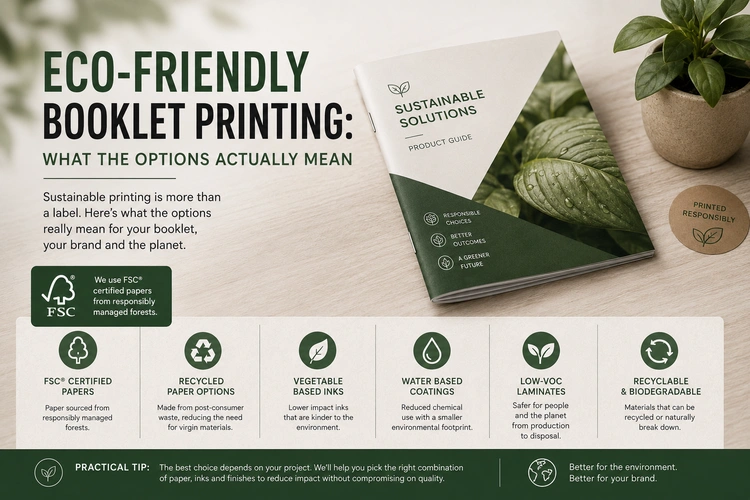
Sustainability has become a standard procurement consideration for many UK businesses — and print is no exception. When you’re ordering saddle-stitched booklets and your brief includes environmental credentials, the language can feel opaque: FSC, PEFC, chain-of-custody, vegetable inks, carbon-offset schemes, recycled content percentages. Most of what’s written on this topic is either vague marketing copy or highly technical. This guide cuts through both: what each claim actually means, what it doesn’t mean, how to verify it, and how to make a spec decision that’s genuinely sound rather than just reassuring to put in a footnote.
The phrase is used loosely across the industry, and it can refer to several quite different things. Treating them as interchangeable — as much print marketing does — obscures what’s actually being offered.
Paper sourcing is the most significant environmental lever in commercial print. It covers where the fibre in the paper came from, whether its harvest was managed to a certified standard, and whether recycled content is used instead of or alongside virgin fibre. FSC and PEFC certification are the main credentialling frameworks here.
Production processes cover how the printing itself is done: the type of ink used, energy consumption at the press and finishing stages, waste management and chemical handling, and water usage. These are harder to verify externally than paper certification, but ISO 14001 environmental management certification gives a meaningful signal about whether a printer is managing these systematically.
Carbon offset schemes allow a print job or a print business to offset its emissions by purchasing credits that fund carbon-reduction projects elsewhere. These schemes vary widely in quality and auditability. Offset is a legitimate tool, but it should sit at the end of a hierarchy — reduce first, then offset what can’t be reduced — not at the top as a simple claim.
The important thing to understand is that a printer can claim “eco-friendly printing” while meaning any one of these things, or a combination of them, or something vaguer than any of them. Knowing which category the claim falls into lets you ask the right follow-up question.
FSC (Forest Stewardship Council) and PEFC (Programme for the Endorsement of Forest Certification) are the two internationally recognised frameworks for responsible forest management. Both set standards for how forests are managed — covering biodiversity, workers’ rights, community impact, and regeneration — and both operate chain-of-custody certification systems that track certified fibre through the supply chain from forest to printed product.
What the logos on paper and on a printed piece mean. When you see an FSC or PEFC logo on a ream of paper or on a printed booklet, it means that the fibre used in that product has been tracked through a certified chain of custody from a certified source. It doesn’t mean the entire forest the fibre came from is perfectly managed in perpetuity — it means the management of that source met the standard at the time of certification and is subject to periodic audit.
Chain-of-custody certification for printers. For the FSC or PEFC logo to appear on your printed booklet, both the paper merchant and the printer must hold valid chain-of-custody certificates. A printer holding FSC CoC certification has been independently audited to confirm they can segregate certified stock, track it through production, and correctly apply the logo. You can verify a printer’s FSC certificate status through the FSC certificate database at info.fsc.org. PEFC operates a similar public database at pefc.org.
FSC vs PEFC in practice. Both are credible international standards. FSC tends to be more widely recognised by end clients and is the more commonly requested standard in UK B2B print. PEFC is the more widely adopted standard globally by volume of certified forest area. For most commercial booklet printing purposes, either certification meets the brief. If your client or sustainability policy specifies one over the other, check the printer’s certificate accordingly.
What neither certification covers. FSC and PEFC are about fibre sourcing, not about the printing process, ink chemistry, energy use, or end-of-life recyclability of the printed product. A booklet printed on FSC-certified stock using conventional petroleum-based inks on a press powered by fossil fuel electricity is FSC-certified but not comprehensively low-impact. Certification is a meaningful and verifiable credential; it’s not a complete sustainability picture.
Recycled paper is the other main sustainable stock option, and the detail matters more than the label.
Recycled content percentages. Paper described as “recycled” can contain anywhere from 30% to 100% recycled fibre. The remainder, where present, is typically virgin fibre — which may or may not be FSC-certified. For the recycled credential to be meaningful, the content percentage and the source of the recycled fibre both matter.
Post-consumer waste vs pre-consumer waste. Post-consumer waste (PCW) refers to fibre recovered after use by consumers — recovered paper collected from households and businesses. Pre-consumer waste refers to offcuts and trimmings from paper manufacturing and print production that never reached a consumer. Both are recycled in a technical sense, but post-consumer waste has a stronger environmental claim because it diverts material from the waste stream that would otherwise have been landfilled or incinerated. 100% PCW recycled stock is the highest-credibility recycled option.
How recycled stock affects print quality. This is where buyers most often have concerns, and the honest answer is that it depends on the stock grade. Lower-grade recycled papers have visible flecks, a grey or off-white base colour, and limited surface coating — they’re unsuitable for full-colour commercial print where image reproduction matters. Higher-grade recycled stocks have improved significantly in recent years: a quality 130gsm recycled silk or uncoated sheet will produce acceptable colour reproduction for most commercial booklet applications, though fine image detail and very saturated colours may not match what’s achievable on a premium virgin-fibre coated stock.
The comparison is most relevant for inner pages. For cover stock, the range of available recycled options is narrower, and getting a sample to assess before committing to a run is strongly recommended. Our booklet paper weight and finish guide covers the quality tradeoffs between stock types in more detail.
Better Printing’s recycled booklet range is available at betterprinting.co.uk/recycled-brochures — a useful starting point for assessing which options are stocked and available for your job.
Ink type is a secondary consideration compared to paper sourcing, but it’s worth understanding what the claims mean.
Vegetable-based inks use oils derived from vegetable sources — most commonly soy or linseed — as the carrier for pigment, replacing some or all of the petroleum-based mineral oils used in conventional litho inks. They are biodegradable, which improves the recyclability of the printed product (mineral oil inks can interfere with the de-inking process during paper recycling). They typically produce equivalent colour quality to conventional inks on coated stocks, and they are now standard or available at most UK litho printers.
UV inks cure instantly under ultraviolet light rather than drying through oxidation or absorption. They contain no volatile organic compounds (VOCs), which is an air quality and worker safety benefit. However, UV-cured inks are harder to de-ink during recycling, which is a trade-off. UV printing is common for certain finishing effects and on difficult substrates, but it’s not inherently more environmentally sound than well-managed conventional litho.
Digital print inks. Toner-based digital printing (the process used for short-run booklets on digital presses) uses electrostatically fused toner rather than liquid ink. Toner residue is more challenging to remove during paper recycling than vegetable-based litho inks. For short runs where digital print is the appropriate process, this is generally accepted as a reasonable trade-off against the environmental cost of running a litho press at low quantity — but it’s worth noting if end-of-life recyclability is a specific concern for your client.
Sustainability in print is most usefully approached as a hierarchy rather than a checklist. The most impactful interventions come first.
1. Reduce the print volume. The most effective thing is to print fewer copies than you don’t need. Over-ordering “just in case” is the single largest source of print waste in commercial print. A realistic assessment of how many booklets will actually be distributed — not how many would be nice to have — is the starting point.
2. Reduce the page count. Fewer pages means less paper, less ink, less energy in production, and lower weight for distribution. A well-edited 16-page booklet is more sustainable than a padded 24-page one, and usually more effective as a communication piece. Our guide to saddle stitch booklet use cases covers page count decisions by application.
3. Choose certified or recycled stock. Once the volume and page count are right-sized, the paper choice is the most impactful remaining variable. FSC-certified virgin fibre or high-percentage post-consumer recycled stock are both credible options. For applications where image reproduction quality is less critical (newsletters, internal documents, text-heavy guides), recycled stock is an easy substitution. For premium marketing pieces where colour fidelity and tactile quality matter, FSC-certified coated stock is the more practical sustainable choice.
4. Use a certified printer. A printer holding FSC chain-of-custody certification and ISO 14001 environmental management certification is operating under independent audit, not self-declaration. These are the minimum verifiable credentials to look for when sustainability is a genuine requirement rather than a preference.
5. Avoid unnecessary lamination. Laminated covers are not recyclable through standard paper recycling streams — the plastic film must be separated first, which most kerbside collection services don’t do. Matt or gloss laminate on a booklet cover that will be used briefly and discarded is a harder environmental choice to justify than on a booklet that will be used repeatedly over an extended period. If the booklet has a short useful life, an unlaminated cover — or a water-based varnish in place of laminate — is a more defensible choice.
If environmental credentials are a genuine requirement for your job, these five questions will tell you what you need to know.
If sustainability is part of your brief, you can explore the full range of saddle-stitched booklets — including recycled stock options — and configure your spec online. Better Printing operates as part The InPrint Group, and the team can advise on certified stock availability and on-product logo requirements before you place your order.

