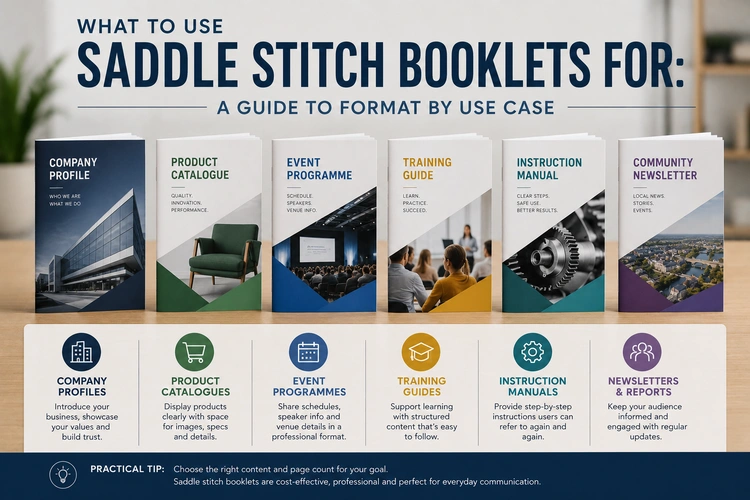
Saddle stitch is the most widely used booklet format in UK commercial print — but “widely used” covers a lot of ground. A 16-page A5 marketing brochure and a 32-page A4 conference programme are both saddle-stitched booklets, and the spec decisions that make each one work are quite different. When you’re ordering saddle-stitched booklets, knowing which use case you’re in makes it much easier to arrive at the right configuration. This guide covers six of the most common applications, with specific spec guidance, the mistakes most often made, and the key design consideration for each.
Marketing brochures are the most common application for saddle-stitched booklets in B2B print. The format suits them well: enough pages for a structured argument, compact enough to post or hand out, and professional enough to leave with a prospective client.
Spec guidance. 8–24 pages, A5 or A4 depending on content density, 130–150gsm silk inners, 300–350gsm cover with matt or soft-touch laminate. For most marketing brochures, A5 is the more practical choice — it posts in a C5 envelope, fits comfortably in a bag, and reads cleanly. A4 suits content-heavy brochures where imagery needs to be large or where data, specifications, or case studies occupy significant space.
The most common mistakes. Under-paging is the more frequent problem: a 4-page or 6-page document isn’t a booklet and doesn’t warrant booklet production costs — a well-designed double-sided A4 or A5 leaflet serves the same purpose at lower cost. The opposite error, over-paging, is also common: a brochure stretched to 40 pages because the client wants it to feel substantial, when the content would be sharper and more readable at 24. A tighter, well-edited 20-page brochure outperforms a padded 36-page one.
Key design consideration. The cover carries disproportionate weight. A marketing brochure may be picked up and glanced at before a reader decides whether to engage further. A 300gsm cover with soft-touch lamination costs more per unit, but the tactile impression at the moment of first contact is the moment the brochure earns or loses the reader’s attention. For budget-constrained runs, matt laminate over a strong cover design is the minimum; gloss laminate alone without a considered cover layout rarely compensates.
For more on how paper weight and laminate choice affect the finished feel, see our booklet paper weight and finish guide.
Event programmes are one of the cleaner use cases for saddle stitch: the page count is almost always in the comfortable range, the run length is defined by the event, and the format is familiar to readers.
Spec guidance. 8–24 pages, A5 portrait as the standard default (though A4 and square formats suit certain events), 130gsm silk inners, 300gsm cover. Lamination is worth considering for premium events — a matt-laminated cover gives a conference programme or awards ceremony booklet a noticeably more polished feel — but is less necessary for community events and sports programmes where cost per unit matters more.
Order-of-service booklets are a special case within this category. Runs are typically small (often 50–200 copies), turnaround is tight (sometimes only a few days from finalised content to delivery), and the emotional context — a funeral, a wedding, a memorial service — means errors or quality shortfalls carry more weight than they would for a commercial brochure. For these jobs: confirm your artwork is complete and signed off before uploading; use a paper stock you’ve verified against a sample rather than guessing; and factor realistic delivery time into your event planning, not an optimistic one.
Key design consideration. Page count planning is the point where event programmes most often go wrong. Content for events is frequently confirmed late, and programmes are often printed before the final speaker list or running order is locked. Build a realistic page count structure early — including holding pages if necessary — rather than trying to repaginate a 16-page document to 12 pages two days before the event. At that point you’re paying for a reprint and creating unnecessary pressure on production.
Product catalogues are well suited to saddle stitch up to a moderate number of SKUs. The format opens flat, which makes it easy to read while cross-referencing or placing an order, and the production cost is significantly lower than perfect binding at comparable run lengths.
Spec guidance. 16–48 pages, A4 or A5 depending on product image size and information density, 130gsm silk inners, 300gsm cover. A4 is generally more appropriate for catalogues where product photography needs scale and specification tables need space. A5 suits product ranges where the key information per item is compact and the format is intended to be used as a pocket reference or carry-away piece.
When a catalogue outgrows saddle stitch. The practical limit is around 48 pages for most catalogue applications. Above that, the booklet becomes thick and unwieldy, and the flat-spine properties of perfect binding — which allows the title and edition to be printed on the spine — become meaningfully useful. If your product range is growing and you expect to add pages each edition, design the catalogue structure with the binding transition in mind from the outset.
Key design consideration. Information density per spread. The most common catalogue design error is allocating too little space per product in an attempt to fit more into fewer pages, resulting in layouts that are crowded and hard to use. A 32-page catalogue with 20 well-presented products will consistently outperform a 24-page catalogue that squeezes in 35. Let the catalogue breathe.
For guidance on paper spec by use case, including how finish affects the reproduction of product photography, our booklet paper weight and finish guide covers the tradeoffs in detail.
Recurring publications — internal newsletters, member magazines, quarterly client updates — are among the most cost-efficient applications for saddle-stitched booklet printing. The format is predictable, the spec can be locked in once and reused, and familiarity for the reader is a feature rather than a limitation.
Spec guidance. 8–24 pages, A4 or A5 depending on content volume, 115–130gsm silk or uncoated inners, self-cover or 250gsm separate cover. Many regular newsletters use a self-cover format — particularly internal publications where cost per copy is a priority — which removes the cover/inner weight distinction and keeps the booklet light and inexpensive. For client-facing publications where brand impression matters, a separate 250–300gsm cover with matt laminate gives a step up in quality without significantly increasing unit cost.
Digital vs litho for repeat runs. Short-run newsletters (under 250 copies) are typically printed digitally, which keeps unit cost manageable at low quantities and allows content to be updated between issues without setup costs. As circulation grows beyond 500 copies per issue, litho printing becomes cost-competitive and delivers better colour consistency and paper quality. If your newsletter is growing in circulation, it’s worth getting a litho quote alongside your usual digital quote at the 250–500 copy threshold.
Key design consideration. Establishing a consistent template. The investment in designing a clear, adaptable page template — consistent grid, typographic hierarchy, fixed header and footer treatment — pays dividends across every subsequent issue. Publications that redesign their layout with each issue spend more time in production and are harder for readers to navigate. Lock the structure; vary the content.
If sustainability matters to your organisation and you’re producing a regular print run, recurring publications are an ideal candidate for FSC-certified recycled stock. Our guide to eco-friendly booklet printing explains what the options genuinely involve and how they compare on quality.
Training materials have specific functional requirements that make saddle stitch a strong choice — provided the page count stays within range and the spec is matched to how the document will be used.
Spec guidance. 20–48 pages, A4 is the standard for most training contexts (larger page size accommodates step-by-step process diagrams and tables comfortably), 130gsm uncoated or silk inners, 300gsm cover. Uncoated inners work better than coated for training materials that participants annotate during sessions — pens and pencils don’t work on gloss or silk surfaces, and participants writing on coated pages will notice the difference. If annotation isn’t required, silk gives sharper reproduction for any technical diagrams or process charts.
The flat-open advantage. This is where saddle stitch has a genuine functional edge over perfect binding. Training materials are often used on a desk while the participant is doing something else — completing an exercise, following a process, filling in a workbook section. A saddle-stitched booklet opens flat and stays open without being held; a perfect-bound booklet at similar page counts tends to close itself. For high page-count training manuals that will be used intensively over time, wiro binding is worth considering — it opens completely flat regardless of page count and holds open reliably. Our saddle stitch vs perfect binding guide covers the broader format comparison if you’re deciding between binding types.
Key design consideration. Structure and navigability. A training manual is a reference document as much as a reading document. Clear section headers, consistent page numbering, and a contents page at the front are functional requirements, not design choices. Participants who can’t find the section they need during a session lose confidence in the material regardless of how well it’s written.
Saddle-stitched booklets are a natural fit for hospitality applications — menus, wine lists, venue guides, spa menus, hotel information packs. The format is familiar to guests, compact enough to sit on a table without dominating it, and flexible enough to be updated with each season or offering change.
Spec guidance. 8–20 pages, square (148 × 148mm or 210 × 210mm) or A5 portrait, 150gsm silk or uncoated inners, 300–350gsm cover. Square formats are particularly popular in hospitality contexts — they have a quality and distinctiveness that A5 portrait doesn’t, and they sit well on a table. Coated inners (silk) give better food and drink photography reproduction; uncoated inners suit establishments that want a more organic, considered aesthetic and where the menu is text-led rather than image-led.
Lamination for durability. Menus are handled repeatedly, often with damp hands, and are cleaned regularly. Matt lamination on the cover extends the usable life significantly. Soft-touch laminate gives an exceptional tactile quality for premium venues, but is slightly more vulnerable to marking than standard matt. Gloss laminate is highly durable and easy to wipe clean, making it a practical choice for casual dining or pub environments where the menu is handled more roughly. Inner pages are not laminated, so for hospitality booklets that are used very frequently, the self-replacing nature of saddle-stitched printing is itself an advantage — a reprint every season is far less expensive than a full rebind.
Key design consideration. Readability in low light. Hospitality environments are often dimly lit, and a menu that looks beautiful in a brightly lit design studio can become difficult to read at a candlelit table. Body text size, contrast between type and background, and the avoidance of reversed-out text in small point sizes are all worth testing under realistic conditions before committing to a print run.
Once you’ve identified your use case and settled on a spec, you can browse and price your saddle-stitched booklets directly online. A5 and A4 formats from 8 pages, short runs from 25 copies, free UK delivery as standard. If you’re not sure which spec is right for your application, the team can advise before you order.

