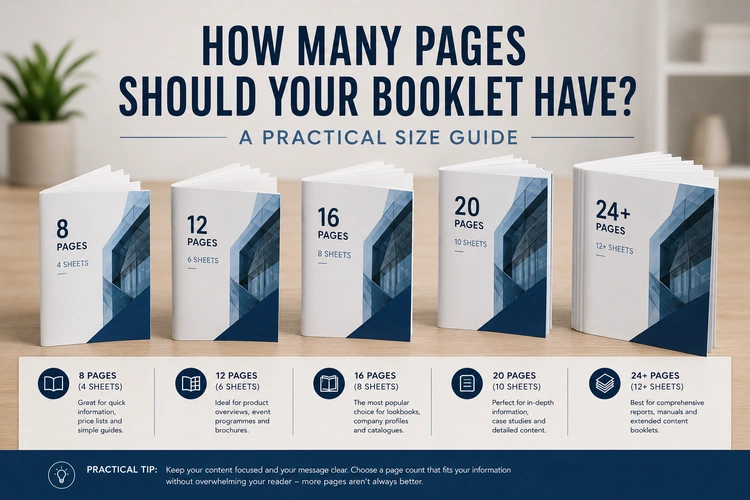
Page count is one of the first decisions to make when ordering a booklet — and one that shapes everything downstream, from how the content is structured to what the finished piece costs and how it can be distributed. When you’re ordering saddle-stitched booklets, there’s a hard technical constraint to work within, but within that constraint there’s real strategic choice. This guide covers the multiples-of-four rule, what different page counts suit, how size interacts with pagination, and when to add or cut pages to get a better result.
The constraint comes from the production process, not arbitrary convention. A saddle-stitched booklet is built from folded sheets of paper. Take a single sheet, fold it in half: you now have four page surfaces — a front cover, a back cover, and two inner pages. Nest another sheet inside it: four more pages. Every additional sheet contributes exactly four pages to the total.
This means your page count must always be divisible by four: 8, 12, 16, 20, 24, and so on. An odd count, or a count divisible by two but not four (10, 14, 18…), doesn’t correspond to a whole number of sheets and cannot be printed as a saddle-stitched booklet.
What to do when your content doesn’t divide by four. The usual solutions are to either add pages or cut them. Adding a page or two is often the more practical route — and those extra pages don’t have to be wasted. The inside front cover, inside back cover, and back cover are all printable surfaces that tend to be underused. Common productive uses for these pages include: a brief introduction or contents list on the inside front cover; a contact details block, map, or QR code on the inside back cover; key product or service highlights, a response device, or a social proof quote on the back cover. Once you start treating these as active design space, reaching the next multiple of four becomes straightforward.
Once the page count is confirmed, the next step is making sure your document is set up correctly — our artwork setup guide for saddle-stitched booklets covers document size, bleed, and export settings for all the main design tools.
The page count shapes how a booklet reads and feels in the hand. Here’s how the main options behave in practice.
8 pages. The minimum for a saddle-stitched booklet. With a cover and three inner spreads, an 8-page booklet is compact and focused — well suited to simple product or service brochures, event invitations with a schedule insert, and concertina-style product cards. At this page count the cover needs to do a lot of work, and the content must be selective. An 8-page booklet on a quality stock with a laminated cover feels more considered than a double-sided leaflet, but it doesn’t invite the reader to linger.
12–16 pages. The most common page count range for commercial marketing booklets. There’s enough space for a structured narrative — an overview spread, two or three product or service sections, and a response or contact page — without the booklet feeling bulky. A 16-page A5 booklet on 130gsm silk inners with a 300gsm laminated cover is a reliable, professional format for a wide range of B2B applications. Product brochures, service overviews, event programmes for smaller gatherings, and short catalogues all sit naturally at this count.
20–28 pages. The mid-range, suited to more substantial content. Product catalogues with more than a handful of items, detailed service brochures with case studies or technical specifications, conference and event programmes, and company newsletters typically land here. The booklet starts to feel like a publication rather than a brochure — readers expect more depth, and layouts can breathe a little more. At 28 pages, perfect binding becomes technically viable as an alternative, though most booklets at this count are still well served by saddle stitch.
32–48 pages. This range is where saddle stitch starts to become more exacting. A 32-page booklet is still comfortably within range on standard 130gsm inners; a 48-page booklet on the same stock is at the upper end. At these page counts the content is substantial — think magazines, annual reports, detailed product catalogues, and training booklets — and the format reads as a proper publication. Square-back finishing becomes worth considering at 40 pages and above, pressing the spine flat for a tidier result.
48–64 pages. The upper range for saddle stitch. This works, but with caveats: inner page weight needs to be moderate (130gsm or below is safer than 150gsm at this count), and square-back finishing is strongly recommended. A 64-page booklet on 130gsm silk is the practical ceiling for most commercial saddle-stitched work. Beyond 64 pages, or where a heavier inner stock is needed, the format begins to resist production and the result shows it.
Format size and page count interact in ways that affect how content reads, how the booklet handles, and what it costs to post.
A4 (210 × 297mm) is the most familiar size for corporate and commercial print. It gives generous space per page — useful for detailed layouts, large photography, data tables, and content that benefits from room to breathe. A4 booklets are slightly unwieldy to carry and don’t mail as economically as smaller formats. For desk-based reading, presentations, and catalogues where content density matters, A4 is the natural choice. Page count tends to run lower relative to content volume, because each page holds more.
A5 (148 × 210mm) is the most versatile size for most B2B applications and the most popular format ordered. It’s compact enough to post in a standard C5 envelope, easy to carry, and still gives adequate space for clear, well-structured layouts. A 16-page A5 booklet will feel complete and well-proportioned; a 16-page A4 booklet can look sparse if the content doesn’t fill it. A5 is the default starting point for most brochures, programmes, and short catalogues.
Square (typically 148 × 148mm or 210 × 210mm) formats have a distinct visual character that works well for creative, lifestyle, and hospitality contexts — menus, portfolio pieces, lookbooks. Square booklets require bespoke layouts and don’t adapt well from content designed for portrait formats. They typically cost slightly more to print due to the trimming waste involved.
DL (99 × 210mm) is the long, slim format that fits a standard DL envelope without folding. It’s well suited to slim booklets of 8–16 pages designed specifically for direct mail — product or service brochures sent as part of a mailing campaign. The narrow format is a constraint on layout but a significant advantage for postage cost and ease of distribution.
For a detailed breakdown of how each size suits different use cases, see our guide to saddle stitch booklet use cases.
The decision between a 16-page and a 20-page booklet, or between 24 and 28, is often more editorial than technical.
Reasons to add pages. A booklet with too little content on each page can feel rushed and thin, even if the total content is sufficient. White space is valuable, but pages that look underdeveloped undermine the investment in the cover and printing. If adding four pages lets you give each section room to breathe, include a case study or testimonial spread, or add a properly designed response page, it’s usually worth doing. The unit cost increase is modest once you’re past the minimum quantity threshold.
Reasons to reduce pages. A booklet padded to hit a page count looks padded. Readers notice when the content doesn’t warrant the length. If cutting four pages means tightening every section and removing material that doesn’t earn its space, the result is a more confident, readable booklet. Fewer pages also means lighter postage, cheaper unit cost, and a less bulky spine — all meaningful considerations at volume.
Using cover pages productively. The four cover pages — outside front, inside front, inside back, outside back — are often underused. In the page count, they’re fixed: every saddle-stitched booklet has them. The question is whether they’re working. An inside front cover with a brief introductory statement and a contents list, and an inside back cover with clear contact information and a call to action, can do more for reader engagement than two extra inner pages of mixed content. Plan these surfaces deliberately rather than leaving them as afterthoughts.
Saddle stitch is the right format for the majority of booklets at 8–48 pages. At the upper end of that range, and beyond it, the case for switching weakens.
At 48–64 pages, saddle stitch remains viable but requires careful spec management — moderate inner weights, square-back finishing, and well-managed margins to account for page creep. For booklets in this range that will be used heavily over time (training manuals, reference guides), the spine staples will eventually show wear. It’s worth asking whether the booklet needs to last.
At 64 pages and above, saddle stitch is no longer practical. The spine is too thick to fold and staple cleanly, and the result looks strained. This is the natural transition point to perfect binding, which handles any page count above the minimum, produces a printable flat spine, and holds up better over sustained use.
At 28 pages and above on heavier inner stocks (150gsm+), the practical ceiling for saddle stitch drops. A 48-page booklet on 150gsm inners is likely to give a poor result; a 32-page booklet on the same stock is near the limit of what folds cleanly.
If your page count is pushing into this territory, our saddle stitch vs perfect binding guide covers the full set of factors — including use case, turnaround, cost, and brand signal — to help you make the call.
Once you’ve confirmed your page count and size, you can get an instant price for your saddle-stitched booklets directly online. The configurator shows available sizes, page count options, and paper stocks side by side, so you can see how the spec affects the price before committing. Free UK delivery on all orders, with short runs from 25 copies.

