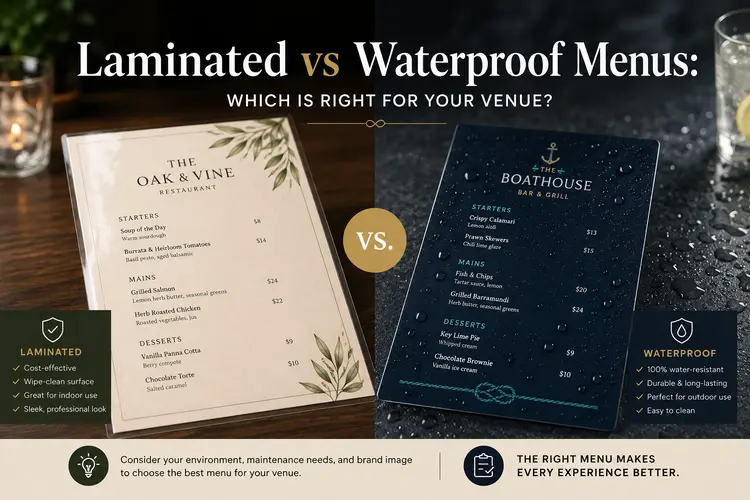
Spills, sanitiser, and constant handling are the reason most hospitality menus don’t last as long as anyone would like. Once you’re past format and onto material, the real decision is between a laminated menu and a true waterproof synthetic menu — and the two aren’t the same thing, even though they’re often marketed as interchangeable. Better Printing’s full range of custom menu printing includes both options, and this guide compares them honestly so you can match the material to how your menus actually get used, rather than to whichever term sounds more durable.
“Waterproof menu” gets used loosely in this market, and it’s worth untangling before comparing options. It can mean a standard paper menu that’s been laminated — sealed between two layers of plastic film, which resists spills as long as the seal holds. Or it can mean a synthetic menu, printed directly onto a single sheet of polypropylene-based material that’s waterproof by construction rather than by a protective coating.
Both will survive a spilled drink. The difference shows up over weeks and months of repeated handling, cleaning, and wear, which is where the rest of this comparison focuses.
A laminated menu starts as an ordinary printed sheet, which is then sealed between two layers of film — usually matt, gloss, or a thicker soft-touch laminate — using heat and pressure. This protects the print from light spills and gives the menu a noticeably different feel depending on the finish chosen.
The weak point is the edge. Because the seal is applied around the outside of the sheet, that’s where moisture can eventually work its way in, particularly under repeated wiping with cleaning sprays or sanitiser, or in venues that run the dishwasher or steam cleaner nearby. Over time this shows up as peeling corners, a hazy or bubbled appearance, or a soft, water-damaged feel at the edges — at which point the menu needs replacing regardless of how well the printed paper underneath has held up.
The paper stock underneath the laminate still matters here, too — a heavier card laminates more cleanly and holds its shape better than a lightweight sheet. If you haven’t settled on a base stock yet, it’s worth reading about the paper stock underneath before specifying a lamination finish on top of it.
A synthetic menu is a different material altogether: a single continuous polypropylene-based sheet that’s printed directly, with no separate lamination step and no seal around the edge. Because the waterproofing is built into the material itself rather than applied as a coating, there’s no edge for moisture to creep in around — the whole sheet behaves the same way, edge to edge.
This generally makes synthetic stock more resistant to tearing and prolonged moisture exposure than a laminated equivalent, and it can still be folded into bi-fold or tri-fold formats provided you specify a grade designed for folding. It’s worth confirming the exact thickness and fold rating with your printer for your specific format, since synthetic stocks vary in weight and flexibility, and not every grade folds as cleanly as paper.
Synthetic menus typically cost more per copy upfront than a laminated equivalent. Whether that evens out depends entirely on how often you’d otherwise be reprinting or relaminating.
In a venue where menus are wiped down between every sitting, handled constantly, or exposed to outdoor conditions, a laminated menu’s edges tend to fail well before the printed content itself looks worn — meaning you’re paying for full replacements more often than the design or pricing on the menu would otherwise require. In lower-handling settings, where menus see occasional spills rather than constant cleaning, lamination’s lower unit cost often remains the more sensible choice, since the durability gap matters less.
There’s a sustainability angle here too: neither option is automatically the “eco” choice, since both typically involve some form of plastic, whether as a laminate film or as the synthetic sheet itself. If that’s a factor in your decision, our guide to eco-friendly menu printing covers the biodegradable laminate and recycled paper options available as alternatives to either standard approach.
Outdoor seating areas, beer gardens, and poolside or terrace dining tend to suit synthetic stock best, since menus left out in changeable weather are exposed to moisture and handling that lamination’s edge seal isn’t built to withstand indefinitely.
Bars and high-turnover counters, where menus get wiped down repeatedly through a shift, are the other clear case for synthetic stock — the lack of an edge seal means cleaning doesn’t accelerate wear the way it does with lamination.
Fine dining venues, where menus are handled carefully and replaced for design reasons well before durability becomes an issue, can often stick with a soft-touch laminated finish for the tactile, premium feel it gives — durability simply isn’t the deciding factor there. The same logic applies to high-turnover takeaway counters with very short menu lifespans: if you’re planning your menu reprints every few weeks anyway because dishes and prices change that often, paying extra for synthetic durability buys you less than it would in a venue that keeps the same menu for a year or more.
A few questions will usually settle it:
If most answers point to frequent handling, outdoor exposure, or a long expected lifespan, synthetic stock is usually worth the extra unit cost. If the menu is handled gently, stays indoors, and gets reprinted regularly anyway, lamination remains a perfectly sound choice.
Once you know which material suits your venue, you can order your printed menus with the right lamination finish or waterproof stock specified, or get in touch if you’d like advice matched to your specific format and handling conditions.

