Most printed materials in a hospitality business stay the same for years — signage, stationery, point-of-sale. Menus don’t. Prices move, dishes rotate, and specials come and go on a timescale that catches a lot of venues out, turning what should be a routine reorder into a rushed, expensive scramble. Better Printing’s custom menu printing service is built around fast, repeatable reordering, and this guide covers how to plan the reprint cycle itself so it stops being an emergency.
A menu carries the most volatile information in the building: prices, ingredient costs, seasonal availability, and allergen details all shift more often than almost anything else a venue prints. A letterhead might go untouched for a decade; a specials-led menu can be due an update within weeks of going to print.
This is partly a reason to think carefully about durability when you’re specifying material in the first place — a menu that’s a more durable material doesn’t go out of date any slower, but choosing the right protective finish for how often the menu is actually handled means you’re not replacing it twice over, once for wear and once for content changes.
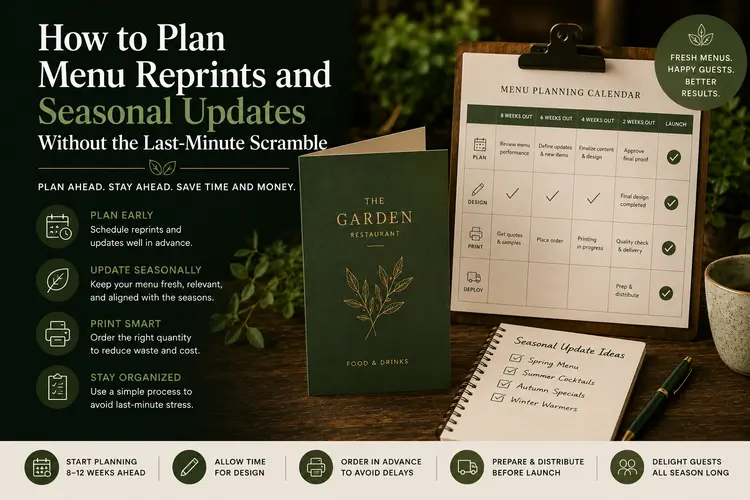
The most effective fix for last-minute reprints is to stop treating them as last-minute in the first place. Map out your known seasonal changes for the year ahead — a spring menu, a summer specials board, Christmas, Valentine’s Day, any other recurring calendar moment your venue marks — and work backwards from each launch date using your printer’s standard turnaround time.
This is also where format matters more than it might seem. The format you’ve chosen affects how disruptive each reprint is: a single page or folded menu is quick and cheap to swap out completely, while a multi-page booklet reprint is a bigger job to plan around if only one section — say, the wine list — actually needs to change.
Every order should include a free digital proof for sign-off before anything goes to bulk production, and it’s worth treating that proofing stage as a genuine checkpoint rather than a formality to wave through. Pricing errors, allergen omissions, and simple spelling mistakes are far cheaper to catch on a screen than on several hundred printed copies.
If colour accuracy matters — particularly for food photography or brand colours — it’s also worth requesting a printed sample alongside the digital proof, since screen colour and printed colour don’t always match exactly.
Standard menu printing typically takes 3–5 working days, which comfortably covers planned seasonal updates if you’ve built the lead time into your schedule. Express same-day or next-day printing is also available, but it’s worth treating that as the option for genuine emergencies — an unexpected price change, a last-minute event booking, a printing error spotted too late — rather than the default way of working.
Relying on express turnaround as standard practice usually costs more over a year than simply planning reprints a week or two ahead of when they’re actually needed.
For restaurant groups managing menus across several venues, consistency is as much a planning problem as a design one. A central template, a single point of contact for ordering, and standardising on a consistent size across sites all make it far easier to roll out a seasonal update everywhere at once, rather than coordinating separate reprints with separate specs at every location.
Where sites do need to vary — different table layouts, different menu holder systems — it’s worth keeping the variation to a documented exception list rather than letting every site drift into its own spec over time, since that’s what eventually turns a simple group-wide update into a project.
Bulk discounts typically apply once an order runs past a few hundred copies, but a bigger discount doesn’t help if half the print run is binned the moment the menu changes. For any menu that’s genuinely short-lived — a seasonal special, a limited-time promotion — it’s usually more sensible to order a conservative quantity even at a higher per-unit cost than to bulk up for a discount on a menu that won’t be in use for long.
The calculation flips for a stable, long-running core menu: if you’re confident it won’t change for six months or more, ordering in volume to capture the discount makes more sense, since the cost-per-copy saving isn’t offset by waste.
Once you’ve got a schedule in mind, you can order your printed menus directly, or get in touch to set up a repeat ordering process if you’re managing reprints across multiple venues or a recurring seasonal calendar.

