Most searches for z fold leaflet printing costs end at a price calculator or a “contact us for a quote” page. Neither tells you what’s actually driving the number. This guide explains the cost levers behind z fold leaflet printing — what each one is, which ones scale with quantity and which don’t, and where it makes sense to spend more versus where spending less makes no difference to the finished result.
A z fold leaflet print run involves four distinct cost components, and understanding which ones are fixed and which are variable helps explain why pricing works the way it does.
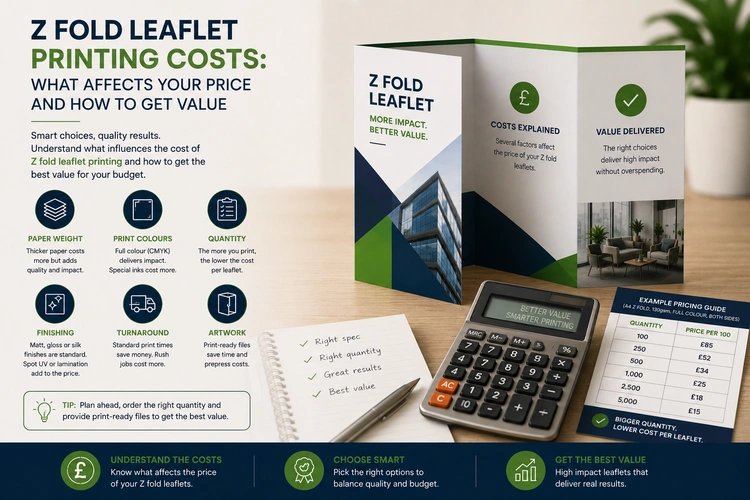
Print covers press time, ink, and setup. On a litho (lithographic) press, there are meaningful setup costs — plates to make, the press to wash and configure — that are largely fixed regardless of how many sheets you print. This is why unit cost falls dramatically as quantity increases. Digital presses have lower setup costs but higher per-sheet costs, making them more economical for short runs. Most online trade printers, including Better Printing, route short runs through digital and larger runs through litho, often around a 1,000–1,250 copy threshold.
Paper covers the cost of the stock itself — weight, finish, and whether it’s standard or speciality. Paper cost scales with quantity and is also affected by weight: heavier stock costs more per sheet to buy and is slightly more expensive to run through the press.
Finishing covers folding, and — on heavier stocks — creasing before folding. Folding a z fold is mechanically straightforward, so folding cost is generally modest. Creasing adds a step and a cost, applied to orders specifying 170 gsm and above. Lamination — if specified — adds another separate cost line, as the sheet must pass through a laminating machine before being folded.
Delivery is a fixed cost that doesn’t scale with quantity. Better Printing includes free UK mainland delivery as standard, so delivery isn’t a variable in most orders.
The key insight from this structure: setup and finishing costs are spread across the print run. A run of 250 bears the same setup cost as a run of 2,000, spread across far fewer units. This is why the jump from 250 to 500 copies typically reduces unit cost significantly, while the jump from 2,000 to 5,000 copies produces a smaller percentage saving.
The relationship between quantity and unit cost is steep at the low end and flattens at higher volumes. A rough illustration of how this typically works:
The practical question is always: how many copies will you actually use? Ordering 1,000 copies because the unit cost is better than 500 makes sense if you’ll use all 1,000. Ordering 1,000 and disposing of 600 because they’ve gone out of date doesn’t.
For seasonal campaigns or content that changes regularly — hospitality menus, promotional offers, event-specific material — smaller, more frequent reprints often give better total value than a large run at a lower unit price. The lower unit cost at 2,000 doesn’t help if 800 copies go to landfill after the season ends.
Paper choice has two effects on cost: the direct cost of the stock, and the knock-on effect on finishing requirements.
A standard 130 gsm silk z fold leaflet is the entry point for most commercial runs — the most cost-effective option available. Moving to 170 gsm silk adds a modest premium on the paper cost, and also introduces the creasing requirement for folded formats, which adds a small finishing cost. The combined increase is typically modest relative to the print cost — but it’s there, and it’s worth knowing about before specifying.
Moving to 250 gsm card is a more significant step up. Card-weight stock costs more per sheet, is heavier to ship, and always requires creasing before folding. If lamination is also specified — as it commonly is at this weight — that adds another cost line. The total premium over a standard 130 gsm unlaminated run can be substantial, particularly at lower quantities where fixed finishing costs aren’t spread across a large volume.
Lamination as a standalone upgrade is worth understanding separately. Applying a matt or gloss laminate adds cost regardless of stock weight — the sheet must be laminated before folding, adding a machine pass. Soft-touch lamination carries a further premium as it’s a speciality process. For a detailed explanation of what each finish actually does to the printed result, see Choosing Paper Weight and Finish for Z Fold Leaflets.
The question to ask before upgrading paper spec is whether the audience will actually notice. For a high-volume event handout that will be picked up, glanced at, and put in a bag, 130 gsm silk does everything you need. For a leave-behind after a client meeting or a hospitality menu that will be handled daily, 170 gsm or above earns its cost through quality signal and durability.
Standard turnaround for z fold leaflets at Better Printing is 7–10 working days from artwork approval. This is the baseline used to price most orders, and it’s the most cost-effective option when your schedule allows for it.
Express turnaround options are available on selected quantities and specifications, but they carry a premium — the press time has to be scheduled at short notice, which displaces other work and costs more to facilitate. The premium for express is typically significant relative to the base print cost, particularly on smaller runs.
The most reliable way to avoid express costs is to build lead time into your planning. If you know a campaign starts on a specific date, work backwards from it: add delivery time, add production time, add time for artwork approval (which pauses the clock if a file needs correction), and add a buffer for the unexpected. Orders placed with a comfortable lead time almost never need express options.
Artwork approval is where turnarounds most commonly slip. If a file is submitted with a problem — RGB colour mode, missing bleed, fonts not embedded — the pre-press check will flag it and production pauses until a corrected file is approved. Every day spent correcting artwork is a day off your turnaround. Getting your file right before submission is the single most effective way to protect your delivery date.
Online print pricing varies considerably, and the cheapest quote for “z fold leaflet printing” is rarely comparing like for like. When a quote comes in noticeably lower than others, it’s usually because one or more of the following is different.
Paper weight is lower. A quote for 115 gsm will be cheaper than one for 150 gsm. At 115 gsm, a DL z fold feels noticeably lighter and less substantial. For some applications that’s fine. For others — trade show handouts, client-facing materials, anything you want recipients to keep — it signals budget rather than quality.
Creasing is excluded. On stocks of 170 gsm and above, some printers quote without creasing and add it as an optional extra. A z fold produced without creasing on heavy stock risks cracking at the fold line. If a quote seems competitive on a heavier stock, check explicitly whether creasing is included.
Turnaround is longer. Some low-cost print operations use longer standard turnarounds — 14 days or more — to batch jobs together and reduce press costs. This isn’t inherently problematic, but it’s worth knowing if you have a deadline.
Delivery isn’t included. Not all printers include delivery. A quote that appears competitive may change once delivery is added at checkout.
None of these trade-offs are automatically wrong for every buyer. But understanding what’s behind a price difference lets you make the comparison fairly. For a fuller picture of how format choice itself affects cost — including whether switching from z fold to a simpler format would save money — see Z Fold vs Tri Fold: Which Format Is Right for Your Leaflet?
Where you can flex without consequence: quantity, if you have genuine flexibility on how many copies you need — ordering closer to your actual requirement rather than rounding up to the next price break is often better value overall. Delivery speed, as long as you’ve built enough lead time to use standard turnaround. Finish, if the end use is mass distribution or a single-use event — standard silk at 130 gsm does the job.
Where cutting cost tends to produce a visible or operational problem: paper weight on folded formats, specifically if you’re specifying 170 gsm or above and creasing is excluded — a cracked fold line is immediately visible and undermines the quality of the rest of the piece. Artwork checking — some ultra-low-cost printers print exactly what they receive without a pre-press check, so if your file has a problem, you find out when the boxes arrive. Turnaround, if your deadline is fixed — an express premium is almost always less expensive than the cost of missing a campaign launch or an event date.
Knowing what your leaflet needs to do is the clearest guide to where in this list your project sits. Our guide to What to Use Z Fold Leaflets For covers seven industry contexts in detail and is a useful reference when you’re deciding how much spec is actually needed for your particular job.
Browse sizes, paper stocks, and turnaround options on our z fold leaflet printing page. For non-standard quantities or bespoke specifications, use the quick quote form or call 023 8087 8037.

