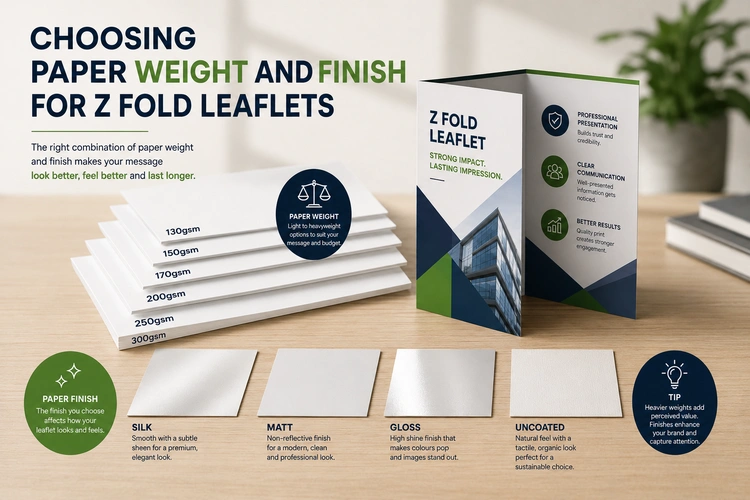
Paper weight and finish are two of the most consequential decisions in any z fold leaflet order, and they’re frequently the ones buyers give least thought to. Most online configurators present a dropdown list of options without explaining what each means in practice — leaving buyers to guess, or to default to whatever they ordered last time.
This guide explains what gsm actually does to a folded leaflet, where the cracking threshold sits, how the main finishes differ in use, and how to arrive at a spec that suits your specific project rather than just ticking a box.
With a flat leaflet, paper weight affects feel and quality signal, but little else. With a folded leaflet, it also affects structural integrity — specifically whether the paper survives the fold without cracking.
When a sheet is folded, the outer surface of the crease is stretched and the inner surface is compressed. On lightweight stocks, the paper fibres flex easily and the fold is clean. On heavier stocks, those same fibres resist the bend. Above a certain weight threshold, the outer fibres can break rather than flex — producing a white, ragged line along the crease that looks unprofessional and weakens the fold over time.
The threshold at which cracking becomes a serious risk in UK commercial printing is 170 gsm. Most UK printers — including Better Printing — crease stocks of 170 gsm and above before folding. Creasing (also called scoring) uses a blunt rule to pre-compress the paper fibres along the fold line, creating a controlled channel for the fold to follow. This reduces, though does not always entirely eliminate, the risk of surface cracking — particularly where heavy ink coverage crosses the fold line.
On stocks below 170 gsm, creasing is generally not required, and the sheet folds cleanly through a mechanical folder. Between 115 gsm and 150 gsm, the paper is flexible enough that cracking is rarely an issue even with dense print coverage.
The practical upshot: if you’re specifying a heavier stock for a premium feel, make sure your printer includes creasing as part of the finishing process. If you’re unsure whether your chosen stock requires it, ask before ordering.
Z fold leaflets are produced across a wide range of paper weights, broadly falling into three practical bands.
This is the lightest range commonly used for z fold leaflets. It’s cost-effective to print in volume, easy to handle, and light enough for bulk mailing without significantly increasing postage costs. The leaflet feels relatively lightweight in hand — not flimsy, but without the substance of a heavier stock. Suitable for promotional inserts, event handouts where quantity matters more than longevity, and any campaign where cost-per-unit is the primary constraint. Most standard z fold print runs default to 130 gsm silk or gloss.
The mid-range is where most B2B marketing material sits. At 150–170 gsm, the leaflet has noticeably more substance in hand, holds its shape when standing in a counter holder, and survives being handled repeatedly without dog-earing quickly. This range suits materials you want recipients to keep — service guides, menus, welcome packs. The additional weight is not significant enough to affect standard postal pricing for DL-format mailers.
At 250 gsm and beyond, you’re moving from paper into card territory. The finished leaflet feels distinctly premium — closer to a business card than a traditional leaflet. This range is particularly common for Z cards (credit-card format z folds), where the rigid feel is part of the product’s appeal, and for showcase materials where quality signal matters — sales leave-behinds, hospitality menus, high-end event credentials. Creasing before folding is standard at this weight range.
Better Printing offers z fold printing across these weight bands. The product pages show the available options for each format — if you need a weight not listed, contact the team before ordering.
Silk is the most popular finish for business leaflets in the UK. It has a subtle sheen — more reflective than uncoated, less flashy than gloss — and produces excellent colour reproduction. Images look rich and saturated without the mirror-like quality of gloss. Text is easy to read. The surface has a slight tactile softness compared to gloss. For most z fold applications — service guides, menus, marketing materials — silk is a reliable default that rarely looks wrong.
Gloss has a high-shine surface that maximises colour vibrancy and contrast. Photography and bold graphic design look striking on gloss. The trade-off is readability: large areas of body text can be harder to read on a gloss surface in certain lighting conditions, as reflections compete with the type. Gloss works best when the design is image-led and copy is concise. It’s also more susceptible to fingerprint marks than silk, which is worth considering for formats handled repeatedly — menus, for example.
Uncoated paper has no surface coating. Ink absorbs into the fibres rather than sitting on top, which produces a softer, slightly warmer colour reproduction — less vib

