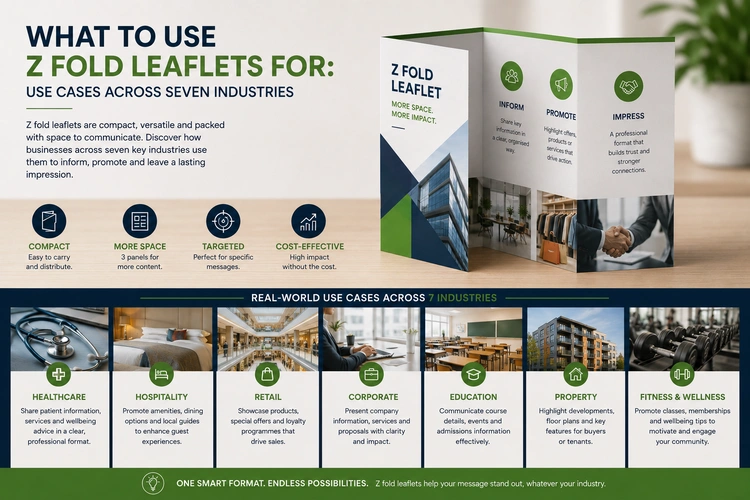
The question most buyers ask before ordering z fold leaflets isn’t “how do I set them up?” — it’s “are these actually right for what I’m trying to do?” Competitor content answers this with a bullet list of sectors. This guide does something more useful: it goes through seven industry contexts in detail, explains what typically works on each panel, and notes where z fold is clearly the right format and where another option might serve you better.
The z fold’s defining characteristic — independent panels that open in a zig-zag sequence — makes it well suited to content that has a natural sectional structure. Each panel can carry a complete, self-contained message. When the leaflet is fully open, all panels are simultaneously visible, which works well for content the reader needs to scan quickly rather than read from start to finish.
This is different from the tri fold’s nested reveal, which functions more like a cover-and-content sequence. The z fold doesn’t have a cover in the same sense — every panel competes equally for attention. That’s an advantage when your content is modular; it’s a limitation when you need a strong single image to pull the reader in before they commit to opening.
For a full comparison of when each format works better, see Z Fold vs Tri Fold: Which Format Is Right for Your Leaflet?
The other structural advantage is that z fold leaflets lie flat when fully open, making them effective for any content that benefits from a wide-format read — maps, timelines, schedules, product comparisons, step-by-step processes. Content that spans all three front panels reads naturally across the full open width.
Z fold leaflets are a natural fit for hospitality. The sectional panel structure maps cleanly onto the natural divisions of a food and drink offering — starters, mains, desserts; food menu, drinks list, allergen information; lunch menu, dinner menu, specials.
A typical DL z fold for a restaurant works like this across six panels: front panel carries the brand and headline; panels two and three open to show the full food menu; the reverse carries the drinks list, dessert menu, or seasonal specials; the back panel holds address, opening times, and booking details. The zig-zag opening is natural for a diner picking up a table menu — no tucking, no unfolding sequence to figure out.
For counter use — leaflets in holders at a bar, café counter, or hotel reception — the DL format fits standard holders without trimming and stands upright cleanly. The fold holds its shape on lighter stocks, which matters for leaflets that get picked up and put back repeatedly.
For hospitality operators running seasonal menus or promotional events, the z fold also allows a partial redesign — updating one or two panels rather than the whole piece — though in practice a full reprint is usually needed since the artwork is on a single sheet.
Six panels is close to the ideal amount of space for a focused product promotion: three products with two panels each, or one hero product supported by features, benefits, pricing, and a call to action.
A retail z fold for a three-product campaign works well with a dedicated panel per product on the front spread — headline, image, one-line benefit — and the back spread holding supporting detail: specifications or size guide on one panel, pricing and stockist information on another, the brand message and contact on the third. The symmetry of three-panels-per-side suits product showcases naturally.
For seasonal campaigns, z fold works better than formats where panels are nested. Because all six panels are equal and the sheet is single-sided in production terms, updating the content for a new season means the same format, same fold, same print spec — only the design changes. That predictability keeps repeat ordering straightforward. For guidance on how repeat ordering and quantity affect unit cost, see Z Fold Leaflet Printing Costs.
Events are one of the clearest use cases for z fold leaflets because the content naturally divides into independent sections: schedule, map, speaker or exhibitor list, venue information, travel, contacts. Each of these can occupy a panel without any of them needing to flow into the next.
At trade shows and exhibitions, the DL and A5 finished sizes both work well for handouts — light enough to carry in volume, compact enough for visitors to pocket. The DL format fits inside a lanyard badge holder at many events, which gives the leaflet a secondary function as an access or reference card throughout the day. Z cards (credit-card sized z folds) take this a step further for organisations that want something a visitor is likely to keep rather than discard. Our guide to Z Fold Leaflet Sizes Explained covers the size options and their postal and handling implications in detail.
For event maps, the z fold’s ability to open fully flat across three connected panels makes it the strongest folded format. A visitor can hold the map open at full width to get an overview, then refold to a single panel for navigation. Gate fold or concertina formats are less convenient for this use case because they don’t sit flat in one hand when open.
Professional services — accountancy, legal, consulting, financial planning, recruitment — commonly use z fold leaflets as leave-behind materials after meetings, for inclusion in proposal packs, and for distribution at networking events and conferences.
The format suits services overviews well. A logical panel structure for a professional services firm might be: front panel with firm name and positioning statement; panel two with a concise services list; panel three with a brief process description (how we work); reverse side with case study or client testimonial summaries; contact details, accreditations, and sector expertise; and a clear call to action with partner names or booking details.
The most common mistake in professional services z fold design is attempting to fill every panel with dense copy. The format physically constrains the space available, and reading six panels of unrelieved text is fatiguing. Each panel works best with one clear idea, a short paragraph, and enough white space that the content can be absorbed quickly. Bullet points, short subheadings, and concise language suit the format far better than full prose.
Estate agents and property developers use z fold leaflets extensively for new development brochures, individual property listings, and area guides. The format offers a practical amount of space for the content a property buyer typically wants: photography, floor plan, key specifications, location, and contact details.
A typical development brochure across six panels: front panel with hero exterior shot and development name; second panel with lifestyle imagery and key selling copy; third panel with apartment or house types and a brief specification summary; reverse side opening with a floor plan on one panel; location map or area overview on another; contact details, reservation process, and legal information on the back panel.
The floor plan panel works particularly well in z fold format because it can occupy one complete panel at DL width (99 mm × 210 mm) without being cramped, and the reader can hold the leaflet open to that panel alone when they want to refer to it. Larger floor plans benefit from the A4 finished format (148 × 210 mm per panel), which gives considerably more space for room dimensions and labels.
QR codes on the back panel have become standard on property z fold leaflets, linking to virtual tours, video walkthroughs, or the development website. If your design includes a QR code, test it at the panel size it will be printed at — QR codes need a minimum of around 20 mm × 20 mm to scan reliably, and some designs attempt to include them too small.
Patient information leaflets, appointment reminders, service guides, and step-by-step procedural instructions are all z fold use cases in the healthcare and public sector. The structured panel format suits step-by-step content well — each step on a separate panel means the reader can work through the process sequentially without having to track where they are on a page.
For healthcare and patient-facing materials, legibility is a priority. Body text should be set at a minimum of 10–12pt, with sufficient line spacing and contrast between text and background. Dark text on a white or very light background is the standard for accessibility. If the audience includes people with visual impairments or older readers, an uncoated stock is often a better choice than gloss — gloss can produce reflections under fluorescent lighting that make text harder to read.
Educational institutions use z fold leaflets for course guides, open day materials, and student-facing information. The compact size works well for prospectus inserts and fresher pack inclusions. For public sector applications — council information leaflets, public health campaigns — unaddressed door-drop distribution is common, and DL z folds fit Royal Mail Door to Door packaging requirements cleanly.
Z fold leaflets suit direct mail for a specific and practical reason: the format holds together when closed without needing to be sealed. The zig-zag structure means there are no tucked-in edges that could spring open during postal handling. A DL z fold slips cleanly into a standard DL envelope, or can be mailed as a self-mailer with the address and postage on the back panel.
For envelope-free self-mailing, apply a wafer seal to keep the leaflet fully closed for postal compliance — even though a z fold holds better than a tri fold without sealing, most postal campaigns use a seal as standard. The back panel of a self-mailing z fold should be designed to accommodate the address area, return address, postage indication, and any required legal small print, while still leaving one or two panels for substantive content.
GDPR applies to personally addressed direct mail campaigns — mail sent to named individuals requires a lawful basis for processing their personal data, and recipients on consumer lists should be cross-referenced against the Mail Preference Service (MPS) before each send. Unaddressed mail — leaflets addressed to “The Occupier” or distributed as door drops — falls outside the scope of GDPR, since no personal data is processed. If you’re using a named list, check ICO guidance or take advice from your data processor before your first campaign.
For artwork setup considerations specific to direct mail z folds — including address panel placement and safe zone requirements around the fold — see our guide to How to Set Up Artwork for Z Fold Leaflets.
Browse sizes, stocks, and turnaround options on our z fold leaflet printing page. If you’re not sure which format, size, or spec suits your project, our team can advise — call 023 8087 8037 or use the contact form.

