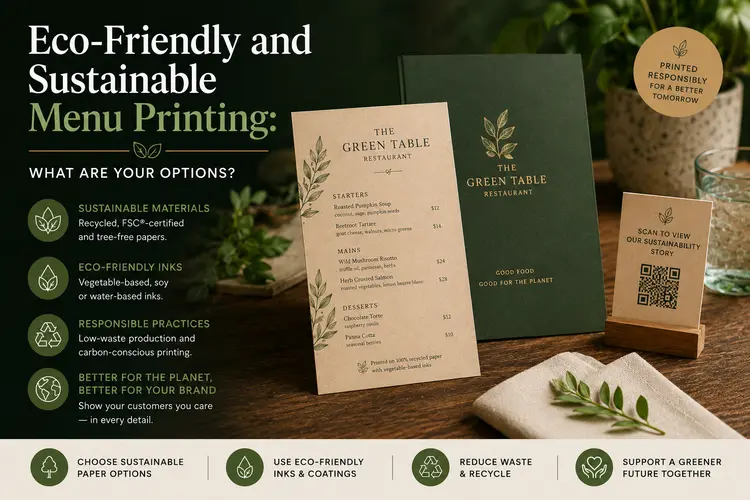
A menu is one of the few printed items a guest actually holds in their hands, which makes it a visible place to back up a venue’s sustainability claims with something tangible rather than a line on a website. Better Printing’s custom menu printing range includes recycled and FSC-certified papers, biodegradable laminate alternatives, and vegetable-based inks, and this guide explains what each option actually means rather than just listing them as a feature.
Diners increasingly notice the small, tangible signals a venue gives off — packaging, table presentation, and printed materials included — and a menu printed on a visibly recycled or certified stock is a low-effort way to make a venue’s wider sustainability efforts legible to the people sitting at the table. It’s also one of the few printed items that gets handed directly to a guest, rather than sitting on a shelf or a website, which makes the choice of paper a more personal statement than most other print in the building.
That said, sustainability claims only carry weight if they’re backed by something real. The rest of this guide focuses on the options that have a genuine basis — certification, material composition, ink chemistry — rather than vague “green” language.
Recycled paper uses a proportion of post-consumer waste fibre rather than virgin wood pulp, reducing the demand for new raw material. FSC (Forest Stewardship Council) and PEFC (Programme for the Endorsement of Forest Certification) certifications work differently: they trace virgin or mixed-source paper back through a chain of custody to forests managed under recognised environmental and social standards. A paper carrying one of these marks isn’t necessarily recycled, but it does mean the fibre’s origin has been independently verified rather than simply claimed.
Both options are available through Better Printing’s menu printing range, and it’s worth knowing how recycled and standard stocks compare on weight and feel before specifying one, since recycled stocks can have a slightly different surface texture and colour reproduction compared with standard virgin paper.
Standard lamination bonds a thin petroleum-based plastic film to the printed paper, which protects it well but makes the finished menu harder to recycle as a single material once the two are combined. Biodegradable laminate alternatives are designed to break down more readily at end of life and reduce the amount of conventional plastic in a laminated menu.
The trade-off is worth understanding before specifying one: biodegradable laminates can behave slightly differently to standard plastic film in terms of feel and long-term durability, so it’s worth discussing the specific application with your printer rather than assuming a like-for-like swap. If you’re still deciding between lamination and a fully waterproof synthetic stock in the first place, our comparison of laminated and waterproof menus covers that decision, including where sustainability fits into it.
Vegetable-based inks replace some or all of the mineral oil typically used in standard litho inks with vegetable oils, which generally lowers volatile organic compound (VOC) emissions during printing and can make de-inking easier when the paper is later recycled. The visual result on the finished menu is essentially indistinguishable to a diner — the difference is entirely in the production process and end-of-life handling, not in how the printed page looks or feels.
“Eco-friendly” on its own isn’t a meaningful claim unless it’s backed by something specific. A menu printed on FSC-certified paper but finished with standard plastic lamination and a heavy single-use card stock isn’t simply “sustainable” overall — it’s a menu with one genuinely verified element among several that aren’t.
The more credible approach is to be specific rather than sweeping: name the certification, the recycled content percentage, or the ink type you’ve actually used, rather than reaching for a general label. This also protects the venue from the kind of vague environmental claim that’s increasingly scrutinised by regulators and increasingly noticed by customers who’ve learned to be sceptical of unbacked “green” marketing.
Most of the protective options that extend a menu’s working life — heavier lamination, fully waterproof synthetic stock — involve more plastic, not less, which sits in some tension with a purely eco-led choice. A lighter, fully recycled, unlaminated menu may need replacing more often than a laminated or synthetic one, which has its own resource cost over a year of reordering.
There’s no single right answer here — it depends on how the menu is used and how much weight sustainability carries relative to durability for your venue. A fine dining menu replaced every season can reasonably prioritise recycled stock with minimal lamination, while a bar menu wiped down nightly may get more genuine environmental value from a longer-lasting material than from a lighter eco-led one that needs reprinting twice as often.
If sustainability is a priority for your next order, you can browse custom menu printing to see the recycled, FSC-certified, and biodegradable laminate options directly, or get in touch and our team can talk through which combination suits your venue.

