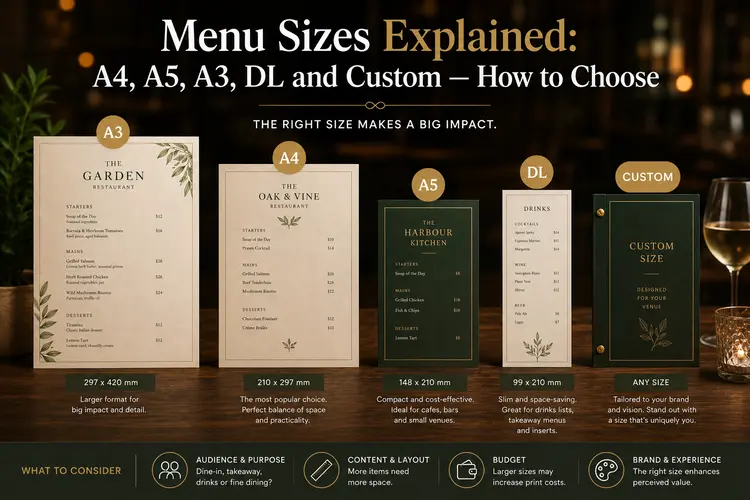
Menu size is one of those decisions that’s easy to default on without thinking — most people reach for A4 because it’s familiar — but the right size depends on what the menu needs to do, where it sits, and what it has to fit into. Better Printing’s menu printing range is available in A5, A4, A3, DL, and custom dimensions, and this guide walks through when each one earns its place.
A4 (210 x 297mm) is the standard size for a reason: it fits comfortably in the hand, sits naturally on a table, and works equally well as a single page, a folded menu, or the page size inside a booklet. For most restaurants with a mid-length menu — somewhere between 15 and 30 items — A4 gives enough space to lay out food and drink clearly without crowding the page or leaving it looking sparse.
It’s also the size most existing menu holders, clip frames, and binders are built around, so if you’re replacing a worn-out menu rather than redesigning a system from scratch, A4 is usually the path of least resistance. If you haven’t settled on the structure of your menu yet, it’s worth reading about choosing a menu format first, since size and format are really one decision split into two questions.
A5 (148 x 210mm) — half the size of A4 — suits content that doesn’t need a full page to say what it needs to say: drinks lists, dessert menus, kids’ menus, or a short specials board that changes daily. Its smaller footprint also means it takes up less table space, which matters in venues where every table is doing double duty for diners, drinks, and place settings.
Because A5 menus print two-up on an A4 sheet, they’re also an efficient size to produce in volume, which is useful if you’re running multiple short-lived menu variants — seasonal specials, daily drinks lists, or limited-time promotions — that need reprinting often.
A3 (297 x 420mm) — double the size of A4 — comes into its own as a placemat-style menu that lies flat across the table, common in casual dining and quick-service venues where the menu doubles as part of the table setting itself. It’s also a practical size for a single-page menu that needs to list a longer offering without folding or running to multiple pages.
The trade-off is space: A3 only works where the table or counter genuinely has room for it, and it’s a less practical size to hand out individually compared with A4 or A5.
DL (99 x 210mm) is the slim, tall format most people recognise from compliment slips and leaflets, and it works just as well as a compact wine or drinks list — narrow enough to stand in a slim holder on a bar or table without taking up much room, while still giving enough length for a reasonably long list of options.
It’s a particularly good fit for bars and venues where the food menu and drinks list are presented separately, since a DL drinks list can sit alongside an A4 or A5 food menu without competing for the same table space.
Not every venue is starting from a blank slate. If you’ve already invested in branded menu holders, clip frames, or binders, a custom size that matches those exactly is often more sensible than forcing a standard size to fit — especially if replacing the holders themselves would cost more than the menus.
Custom sizing is also worth considering for unusual table layouts, bespoke binder systems, or menus that need to match an existing point-of-sale display. Better Printing can produce menus to bespoke dimensions, so if a standard size doesn’t quite fit what you’re working with, it’s worth asking rather than compromising on the design.
For restaurant groups or multi-site operators, picking one or two sizes across all locations makes life considerably easier — design templates carry over cleanly, reorders are simpler to manage, and stock levels are easier to predict. It also means new sites can be brought online with the same menu system rather than designing something bespoke for each location.
The complication is that not every site necessarily has the same table layout or menu holder system, particularly if some venues were acquired rather than built to a single spec. Where that’s the case, it’s often worth standardising the core size for new openings going forward while accepting some legacy variation at existing sites, rather than trying to retrofit everything at once. This kind of decision overlaps closely with planning reprints across multiple sites, since the size you settle on affects how reordering works at scale.
Once you’ve settled on a size, you can browse custom menu printing in A5, A4, A3 and DL directly, or get in touch if you need a bespoke dimension to match existing holders or table settings.

