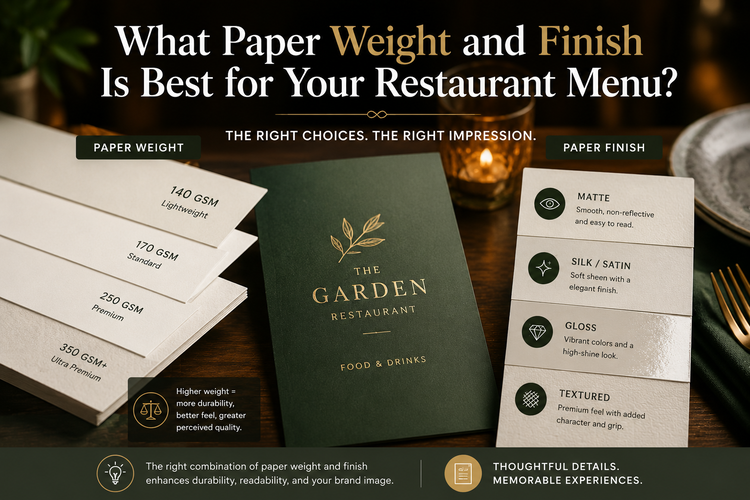
A menu printed on the wrong stock looks the part in a design file and then disappoints the moment it’s in someone’s hands — too floppy to hold its shape, too heavy to fold where it needs to, or glossy enough to glare under restaurant lighting. Paper weight and finish are practical decisions as much as aesthetic ones. Better Printing’s menu printing service covers a range of weights and finishes to suit different menus, and this guide explains which combinations work where.
Paper weight is measured in grams per square metre (gsm) — the higher the number, the heavier and thicker the stock. Go too light for a menu that’s handled repeatedly and it feels insubstantial, picks up creases at the corners, and tears at fold lines faster than it should. Go too heavy for a folded format and you risk a stiff, awkward fold that won’t lie flat or close cleanly.
Finish matters just as much, but for different reasons: it affects how legible the menu is under your lighting, how it resists fingerprints and light spills, and how it feels when a customer picks it up. None of this is purely cosmetic — it’s the difference between a menu that still looks good in month three and one that needs reprinting after a few weeks of service.
The right weight also depends on which format you’ve chosen — a tri-fold menu needs to fold cleanly without cracking, while a single page table menu that never folds can comfortably take a heavier, sturdier card.
For menus that are handled briefly and reprinted often — takeaway menus, leaflets, single-use specials — a lightweight stock in the 130–250gsm range, finished in gloss or silk, is usually the right call. Gloss gives strong colour vibrancy, which suits menus with food photography. Silk (sometimes called satin) sits between matt and gloss, giving good colour reproduction with less glare.
This weight range also keeps unit costs down, which matters if you’re reprinting every few weeks as prices or dishes change. If sustainability is part of your decision at this stage, it’s worth knowing about recycled and FSC-certified options before committing to a standard stock, since several are available at comparable lightweight gsm bands.
A menu that sits on the table and gets picked up, propped against a holder, or handed between diners repeatedly through a service needs more substance than a takeaway leaflet. Card in the 300–350gsm range holds its shape under regular handling, resists dog-earing at the corners, and simply feels more considered in the hand — which matters for how customers perceive the venue before they’ve even read a dish description.
This heavier card is also the more sensible base for any menu that’s going to be laminated, since a lightweight sheet underneath a laminate finish can feel thin and flex more than it should.
Each finish does a different job:
Finish and lamination aren’t quite the same decision, though they’re closely linked: a finish like soft-touch is typically applied as part of a full lamination process, which brings its own durability trade-offs. If you’re choosing between a laminated finish and a fully waterproof synthetic stock, our comparison of laminated vs waterproof menus covers that decision in more depth.
As a working rule: the more a menu gets handled, wiped, or exposed to spills, the more weight and protection it’s worth specifying. A drinks list handed out once and read for a few minutes doesn’t need the same spec as a table menu that survives weeks of nightly service.
For high-handling menus, pairing a heavier card (300gsm+) with a protective finish — lamination or a waterproof synthetic stock — gets the longest practical lifespan. For low-handling, frequently updated menus, a lighter stock with a simple gloss or matt finish keeps costs down without sacrificing anything that actually matters for how the menu is used.
| Venue type | Suggested weight | Suggested finish |
|---|---|---|
| Takeaway / delivery menu | 130–170gsm | Gloss or silk |
| Café / bistro single page menu | 200–250gsm | Matt or silk |
| Full-service restaurant table menu | 300–350gsm | Matt, soft-touch, or spot UV accents |
| Fine dining menu | 300–350gsm | Soft-touch lamination |
| Bar / drinks list (handled frequently) | 300gsm+ | Lamination or waterproof synthetic stock |
Treat this as a starting point — your printer can advise on adjusting weight or finish if your venue’s handling conditions sit outside the typical range.
Once you’ve settled on a weight and finish, you can browse custom menu printing to see the available stocks directly, or get in touch for advice matching a spec to your specific menu and venue.

