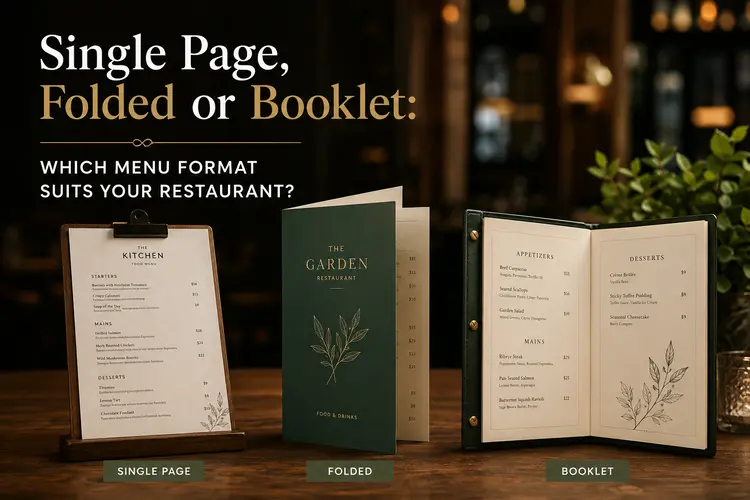
Before you get to paper or finish, there’s a more basic question to settle: what shape should your menu actually take? A short specials board and a full à la carte menu with a wine list don’t belong in the same format, and getting this wrong means either a cramped page or a menu that feels padded out. Better Printing’s custom menu printing range covers single page, folded, booklet, wiro bound, table talker and tent card formats, and this guide walks through how to pick between them based on what you’re actually putting on the page.
Start by counting, not designing. The number of items you need to list — food and drink combined — does more to determine the right format than brand style or budget ever will.
As a rough guide: under around 15 items usually fits comfortably on a single page or a simple fold. Between 15 and 30 items, spread across courses or sections, tends to need either a folded format with more panels or a short booklet. Beyond 30 items — particularly if you’re running separate food, drinks, and specials sections — a booklet or wiro bound menu gives you room to organise without shrinking the type size to fit.
It’s also worth thinking about how the format affects size. A tri-fold menu printed on a single A4 sheet gives you six panels of content without adding a single page, which is often enough to avoid stepping up to a booklet. If you’re not sure how page count and physical size interact, our guide to menu sizes explained covers how A4, A5, A3 and DL formats each accommodate different amounts of content.
If your menu is short and changes often — a daily specials board, a drinks list, a lunch set menu — single page and folded formats are usually the right call. A single page menu, printed double-sided on A4 or A5, is the simplest and cheapest format to reprint, which matters if you’re updating prices or swapping dishes every few weeks.
Folded menus extend this without adding pages. A bi-fold gives you four panels; a tri-fold gives you six. This is particularly useful for takeaway and delivery menus, where a single folded sheet needs to cover starters, mains, sides, drinks and ordering information without becoming a multi-page document that’s awkward to fold into a bag or letterbox.
Because these formats are quick and inexpensive to reprint, they’re also a sensible starting point if you expect your menu to change shape over the next few months — you’re not committing to a binding method or page count you might outgrow. The paper itself still needs thought, though: a folded takeaway menu handled in wet or greasy conditions needs a different stock to a single page menu sitting on a table indoors. Our guide to choosing the right paper weight and finish goes through which weights and finishes suit which level of handling.
Once a menu runs to multiple courses, a full drinks list, and perhaps a separate wine or cocktail section, a booklet format gives you the structure a single folded sheet can’t. Saddle-stitched booklets — stapled through the spine — work well for menus up to around 24-32 pages and are the more economical of the two booklet options.
Wiro bound menus use a coiled wire spine instead, which lets the menu lie completely flat and open through a full 360 degrees — useful on smaller tables where a propped-open booklet takes up more room than it should. Wiro binding also handles mixed-thickness pages well, so a heavier laminated cover with lighter inner pages isn’t a problem. If only one section of your menu changes regularly — a seasonal wine list, for instance — it’s worth asking about reprinting just that section and having it rewired in, rather than reprinting the whole booklet every time.
Table talkers and tent cards aren’t a replacement for your main menu — they’re a way to promote something specific without redesigning the whole thing. Their folded, free-standing structure means they sit upright on a table or counter, usually with three or four panels, only one of which is visible to the customer at a time.
This makes them well suited to content that changes faster than your core menu: a weekly special, a seasonal cocktail, an upsell like desserts or side dishes. Because they’re cheap to produce in short runs, they’re also a practical way to test a new dish or promotion without committing to a full menu reprint if it doesn’t stick.
The way customers interact with your menu in practice should weigh as heavily as dish count. For full table service, a single page or booklet menu handed to each diner works well, since there’s time for customers to read it properly. For counter or quick-service settings, a single page menu — sometimes mounted or laminated for repeated handling — tends to work better than anything that needs to be opened and read at length while a queue is forming.
Takeaway and delivery service has its own pressures: menus need to survive being posted through letterboxes, handled with greasy fingers, and often kept for weeks before the next order. A folded format usually wins here on practicality, but the material matters just as much as the shape. If you’re running a bar or a high-turnover counter where menus get wiped down or handled constantly, it’s worth reading our comparison of laminated vs waterproof menus before finalising your spec, since not every format takes lamination equally well.
| Venue type | Typical item count | Recommended format |
|---|---|---|
| Fine dining / tasting menu | 5–12 dishes | Single page or short folded menu |
| Café / bistro | 10–20 items | Single page or bi-fold/tri-fold menu |
| Casual dining restaurant | 20–35 items | Tri-fold menu or short booklet |
| Full-service restaurant with wine list | 30+ items across sections | Saddle-stitched or wiro bound booklet |
| Takeaway / delivery | 15–40 items | Folded menu, sized to fit letterboxes and bags |
| Bar / pub | Drinks-led, frequent changes | Single page or folded drinks menu, plus table talkers for specials |
Use this as a starting point rather than a rule — a small venue with an unusually long wine list, for example, might still need a booklet even with a short food menu.
Once you’ve settled on a format, you can browse custom menu printing to see single page, folded, booklet, wiro bound and table talker options directly, or get in touch if you’d like advice on matching a format to an unusual page count or venue layout.

